INDIVIDUAL DIAGRAM
2.27.2011
Revofev
Within our groups from JENGA 3.0 we were to diagram our books that we had selected to read for the semester. We also had to do a individual diagram explaining our book, I had chosen to read Towards A New Architecture, Abigail was reading Biomimicry, and Austin was reading House Form and Culture.
Tags:
Environmental Design IV,
Graphics
JENGA 3.0
Tags:
Environmental Design IV
2.20.2011
The Pillsbury Doughboy Or The Michelin Man?
So Dajana (my wife... kinda, she'll tell you otherwise but she really is) did this nice little drawing of me yesterday saying this is who I remind her of.
I'm just gonna say that I'm not too sure how I feel about it just yet.
Tags:
Fun Stuff
2.15.2011
Sorting The Pieces To No Puzzle
Once again building off of our last project, that being JENGA 2.0 we have began 3.0 in which we are working in groups of three and combining the three spaces into one sort of cohesive complex. I am having the pleasure of working with Abigail Buchanan and Austin Loman. Monday we were to turn in a team proposal which stated our name (JIVE STUDIOS), theoretical position, design approach, goals and a slew of other things. Along with that we were to once again compose a narrative of our three spaces blending together as well as a diagram explaining certain ideas.
NARRATIVE
Arranging the three units adjacent to one another, an implied square is formed around the perimeter of the exterior walls. By shifting two of the units outward, the structures seem to be gliding across the landscape while still keeping an implied boundary of a perfect square. The connecting element of the three spaces is a second floor balcony speaking to the notion of joinery while also creating an interior public space below. Groove is implied by a series of corridors leading from exterior to interior as well as public to private. Individual private spaces are accessible from both the ground floor and the second floor balcony. The units are arranged in a fashion that creates nine means of egress. Three modes of egress on the second floor move from the public to private spaces, while two lead from the second floor to the ground floor. On the ground floor the four means of egress are located on each axis of the structure connecting the interior with the exterior.
DIAGRAMS
INITIAL
REVISED
Tags:
Environmental Design IV
Who's Lynda?
In my IAR 212 class we just wrapped up our second project, the first one being a precedent file library called the Open Library™. Anyways the new projects goal was to do an entire rendering using Photoshop. This rendering though happened by layering material and textures on top of a wireframe file that our professor had provided us with. Below was my final outcome for my rendering...
Tags:
Visual Communications II
2.11.2011
JENGA 2.0
Our next project in studio was an extension or continuation from our last project, 1.0. In this project our professor assigned us one of the three spaces from the first project. The space I was given was my first space which concentrated on the notion of smooth and sleek materials and very straight in its shape. This was my first space...
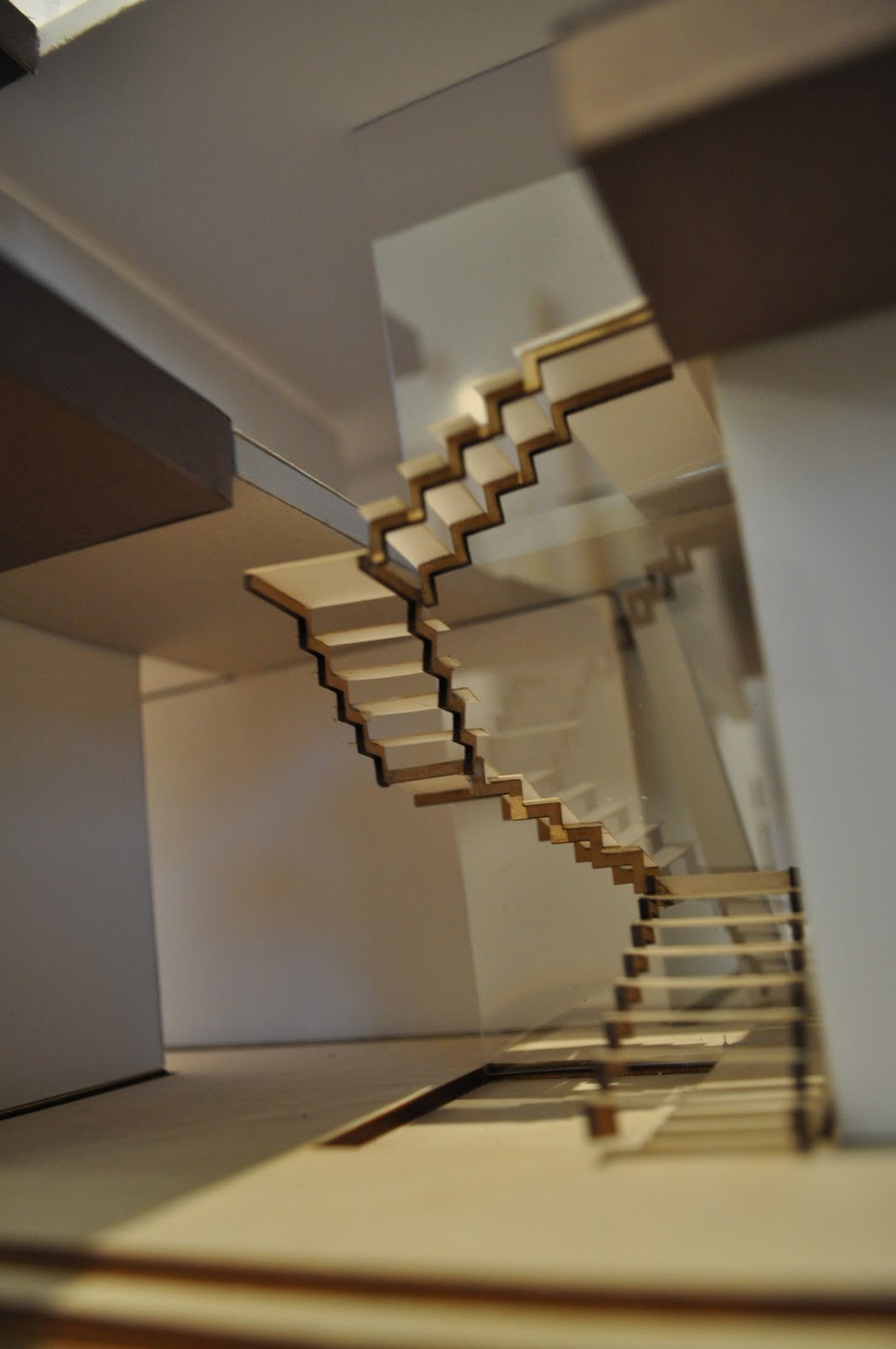
Anyways, the new 2.0 assignment gave us another space/level to work with that either went above or below the original and accounted for 50% of the original unit. So with my new space I chose to work below my previous floor and having the smallest space the stairs were my most difficult task I faced. I chose some stairs/lifts that I saw in a project from last semester, the Wyly Theatre which use a hydraulic system.
We had to produce more technical drawings, such as floor plans, one section, and three additional drawings. I assembled all of these components on a board and then produced yet again, another model.
Tags:
Environmental Design IV
2.10.2011
2.01.2011
Peer Review: Leslie
Leslie Canipe created three units as well, but based around the word deviate. Leslie’s word along with Sharece’s was based much on the movement of humans in the space. It only makes sense to base much of what they designed to be reflected by movement itself. Leslie worked around the scheme of glow, seduction and chance and in experimenting with these words Leslie designed something which engaged, forced, confused and provided one with a journey.
The first space she composed in a way that light throughout the unit pours in due to the six windows that make up one wall. This natural light illuminating the space can also be altered because Leslie informed us that there would be some sort of shade or panel to pull down to bring in more light or block light.
DIAGRAM OF SPACE
Seduction is the theory of the second space, upon entering the space you are greeted by a wall directly in front of you. This territory was one meant to engage the person and also provide a uncomfortable scenario in which your forced to decide between one of two paths.
DIAGRAM OF SPACE
In the last allocation of space, the theme that guided her design was “chance”. The person entering the room immediately feels overwhelmed and possibly confused. To your left towers two columns and behind that is a wall off kilter. Circulation in this space is up to the being completely, a adventure within in this space is the central theme.
DIAGRAM OF SPACE
Tags:
Environmental Design IV
Peer Review: Sharece
Sharece Ramos’ and her three spaces all revolved literally on that very concept word itself... “revolve”. Sharece portrayed the idea of revolutions in two units by physical manipulation of the space itself. In her third space she had the intention of people being navigated by her kit of parts solely.
In her first space her kit that she selected was the two solids, and what these to is move to create new and different spaces for various functions. Her idea in designing this overall space was to “revolve around an idea” and I believe this space accurately displays that in being able to maneuver the kit itself.
DIAGRAM OF SPACE
The next square unit is based around creating a central point in the space, that being a column and being able once again to physically move something. The something in this space being the two walls that are hinged to the column to create an orbital path of sorts. This space can allow for designating more room to a space just by simply moving a wall which is a nice idea that could really create something interesting.
DIAGRAM OF SPACE
Lastly in the largest space she utilizes the two columns and one wall kit. What this kit allows her to do is to force the user to be guided or revolve around the space in a particular manner that she has created. Also the columns create a sense of privacy in which to allocate space for the bathing and washing facilities needed.
DIAGRAM OF SPACE
Tags:
Environmental Design IV
Subscribe to:
Posts (Atom)